When a customer sends out a request for quote, everyone wants the same thing: a fast, accurate quote and a smooth path to production.
But the quality of the RFQ has a huge impact on both.
A strong RFQ helps a machine shop understand exactly what the part needs, what matters most, and where potential issues may exist before work ever begins. A weak RFQ can lead to delays, questions back and forth, inaccurate pricing, and surprises once the job is underway.
If you are sourcing precision machined parts, tooling, carbide components, or tight-tolerance work, here is what makes an RFQ more useful for both your team and your manufacturing partner.
Start With a Clear Print or Part Drawing
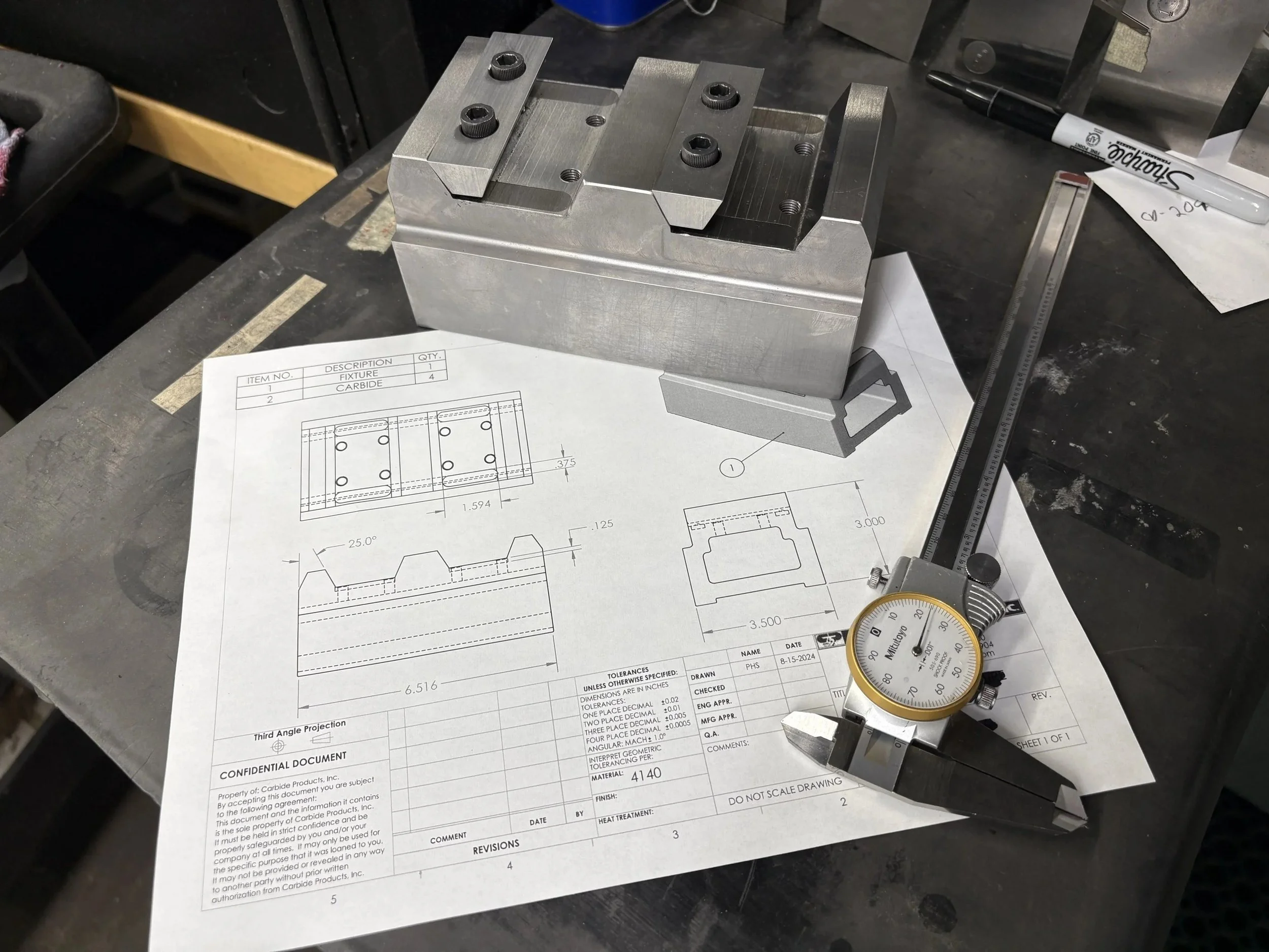
The most important part of any RFQ is the drawing.
A complete, readable print gives the shop a foundation for quoting the part correctly. This should include all critical dimensions, tolerances, material requirements, finishes, thread details, and any notes that affect manufacturing.
If you have a 3D model, send that too. A STEP file or similar model can help clarify complex geometry, but it should support the drawing rather than replace it unless both parties are aligned on model-based definition.
At minimum, your RFQ should include:
a current revision drawing
clear dimensions
tolerance requirements
material callout
any special notes tied to manufacturing or inspection
If multiple revisions are floating around internally, make sure the correct one is the one being quoted.
Clearly Identify Critical Features
Not every dimension matters equally.
One of the biggest ways to improve an RFQ is to identify the features that are truly critical to function. That may include a tight diameter, a ground surface, a sealing face, a positional tolerance, or a feature that mates with another part in an assembly.
When a shop knows what is most important, it can make better decisions during quoting and process planning. It also helps avoid over-processing non-critical features, which can drive cost up unnecessarily.
If certain dimensions are especially important, call that out directly in the print or in the RFQ notes.
Specify the Material — and Be Precise
“Steel” is usually not enough.
Material selection changes tooling, cycle time, heat treat needs, grind requirements, and overall quote accuracy. If the part calls for carbide, hardened tool steel, stainless, aluminum, or a specialty alloy, that should be clearly stated up front.
Helpful material details include:
exact material grade
hardness requirements
whether material is customer-supplied or shop-supplied
If there is flexibility in the material, that is useful to mention as well. In some cases, a shop may be able to suggest an equivalent or more machinable option depending on the application.
Include Quantities and Expected Release Pattern
A quote for 2 pieces is not the same as a quote for 200.
The quantity you need affects setup cost, cycle time assumptions, inspection planning, fixture choices, and whether a process is practical at all. It also helps the shop determine whether this is a prototype, short-run, or production opportunity.
Be clear about:
quote quantity
annual usage if known
whether this is a one-time order or repeat work
whether multiple releases are expected
Even a rough forecast is better than none. A shop can price more intelligently when it understands the bigger picture.
Call Out Surface Finish, Coating, and Secondary Operations
Many RFQs leave out details that end up being major cost drivers.
If the part needs grinding, EDM, laser marking, coating, plating, passivation, heat treat, brazing, assembly, or other secondary work, include that up front. These are not minor details. They can change both routing and lead time.
The same goes for cosmetic expectations and surface finish requirements. If a finish matters, define it. If it does not, that is also useful to know.
The more complete the scope is at quote stage, the better the quote will reflect reality.
Share the Timeline Honestly
Lead time matters, but context matters too.
If you need a part urgently, say so. If you are still budgeting for a future release, say that too. A good manufacturing partner can usually respond better when it understands the business need behind the request.
Helpful timeline details include:
desired delivery date
whether the job is urgent, standard, or flexible
whether partial shipments are acceptable
A realistic timeline helps prevent rushed assumptions and opens the door to better communication.
Mention Inspection or Certification Requirements
For precision machined parts, documentation can be just as important as the part itself.
If you require first article inspection, material certs, dimensional reports, special packaging, traceability, or any industry-specific documentation, include that in the RFQ.
These requirements affect the quote and should not be an afterthought.
Some common callouts include:
first article inspection report
material certifications
certificate of conformance
in-process or final inspection records
traceability requirements
special packaging or labeling
If the part is going into a regulated or high-risk application, that is worth noting as well.
Explain the Application When It Matters
A shop does not always need to know exactly where the part is used, but a little context can go a long way.
Knowing whether a part is part of a cutting tool, fixture, wear component, aerospace assembly, industrial machine, or prototype can help a manufacturer better understand what matters most. That can influence recommendations around tolerancing, material choice, manufacturability, and risk.
You do not need to over-explain. Just enough context to guide smart decisions.
Include Contact Information for Questions
Even a strong RFQ may raise a few questions.
The fastest way to keep things moving is to include the name and contact information of the person who can answer technical or commercial questions quickly. Waiting days for clarification slows down quoting and production planning.
A simple point of contact helps keep the job from stalling before it starts.
What Slows Down a Quote?
Some of the most common RFQ issues are simple but costly:
missing drawings
unclear revisions
incomplete material callouts
no quantity listed
no tolerance guidance
secondary operations not mentioned
no clear contact for follow-up questions
None of these automatically kill a job, but they do make it harder to provide an accurate quote quickly.
A Good RFQ Leads to a Better Manufacturing Outcome
A well-built RFQ does more than help a shop price the job.
It improves communication, reduces assumptions, speeds up review, and increases the chances of getting parts made right the first time. For precision machined components, especially those involving tight tolerances, carbide, grinding, EDM, or multiple operations, clarity early on pays off.
The best RFQs are not necessarily the longest. They are the clearest.
If your team has a print, a part model, or even an early concept that needs review, sending complete information up front is the best way to start the conversation.
Need help reviewing a part for manufacturability or quoting? Send us your drawing, quantity, material, and timeline, and we can help you evaluate the next step.